Friday, February 24, 2012

Author-Artist Shanahan Debuts With Auryn

There's no denying that the way children read books and "experience" stories -- whether through gaming, downloading digital books, watching YouTube, recording videos of their stories themselves -- is changing. And storytelling is transforming right along with it. For authors and illustrators of children's books, picture book apps offer an exciting new frontier.

Sue Shanahan is one such author-illustrator who has ventured into app-land. A longtime artist focused on children, she decided to give it a go and see her work produced in digital form rather than book. Working with top-notch app producer Auryn, whose Teddy's Day, Teddy's Night, and Miko series have earned rave reviews, she has created the adorable Love You to the Moon and Back for the iPad. We asked Sue to share how she broke into the picture book app market.

dotMomming: How long have you been illustrating for children. Is the Love You to the Moon and Back app your first digital book?

Sue Shanahan: My career illustrating for children began over 30 years ago. I've been fascinated with the human form for as long as I can remember. On top of that, I'm crazy about kids. So illustrating for children was a natural fit. Love You to the Moon and Back is my first digital book. It was made from pre-existing art that I own the copyright to. With the help of a couple of SCBWI members, I wrote the poem the art illustrates. Right now I’m working on finishing up the illustrations for another picture book app for Auryn. This is a full-fledged story that’s been milling around in my brain for a years. I am very excited about finally bringing it to fruition. I have my fingers crossed that Auryn will produce it into a premium app like Teddy's Day.

DM: Was it hard to break into the app market? Have you knocked on a lot of doors, or was Auryn your first?

SS: Actually, Auryn was my first. I was surprised how quickly they called after my submission. They liked my work, but it also was extremely important that I owned the copyright to everything.

DM: Author-illustrators are particularly attractive to publishers, both in the digital realm and the printed page. Do you feel you're at an advantage compared with other writers and artists trying to catch an editor's eye?

SS: Definitely. I have a feeling with new apps, Auryn only is interested in picture book author/illustrators. They have been producing apps from pre-existing picture books but only if the book company no longer owns the rights.

DM: The Love You app merges beautiful illustrations with gentle interactivity that reinforces reading. While it can be read alone, it offers great engagement opportunities for parents to record their voices and share the message of unconditional love. Are you happy with the results of your work when you see it on the iPad.

SS: It is a wonderful feeling to read my book on the iPad. The illumination from behind brings my art to life unlike being reproduced on the printed page.

DM: Publishing in the iTunes store is a different experience than in the bookstore down the street. Love You is priced at $0.99. How have sales been so far? Would you do it all again?

SS: The app sales are moving along steadily. I was told not to worry about the sales at this point. It takes awhile for them to gain a momentum. I do appreciate the wonderful reviews customers are giving it in iTunes. Yes, I would do it again. I think this is where books are going. It's exciting to be in on the ground floor.

DM: I liked the inclusiveness of your illustrations -- children are features from all walks of life, including a little girl with Down's syndrome. This is so rare to see in a mainstream picture book. How has the book been received so far?

SS: My art has always reflected the beauty of all kinds of kids. Long ago, I was miffed when an art director insisted I stylize my art like the "Gerber Baby." I stubbornly refused to. My thought was, “How is a child supposed to feel good about herself if there are no images of her in the world?” Who decides what's beautiful anyway? One of my heroes is Norman Rockwell. I figured if capturing real people worked for him it could work for me too. Today people respond to the diversity in my art. Truly, what's different about us is what makes us beautiful.

Tuesday, February 14, 2012

Grover Takes Home Cybils for Best Book App

The Cybils were announced today, and I am delighted to see The Monster at the End of this Book as the winner in the brand-new Best Book App category. Sesame Workshop and Callaway DigitalArts get it right with this effort, engaging young readers in the truest sense through highlighted text, hilarious narration, and a fun storyline. While often we see kids zone out with digital devices, Monster leaves no room for passive observing: Grover spends all his time trying to keep the reader from turning the page and getting to the end of the book. It is an app they'll go back to again and again.

Judging for the Cybils was an honor and a thrill because this new medium is still so wide open. And our expectations for what picture book apps can and should be are so varied. Looking at the finalists, you can see the range of styles: Hildegard Sings stays true to its picture book roots with traditional presentation of text and adorable interactivity. For young readers, it feels like a natural extension of a book, with a great deal of fun added in. Click on thought bubbles to see what characters have in mind, tap on a plate of food to feed our hungry hippo, throw tomatoes at the stage after a performance. Hildegard is a great example of an "enhanced" book, taking something that worked great in the paper world and making it interactive and fun for the digital one.

At the other end of the spectrum is Bobo Explores Light, which is a completely original book that takes the game to a whole new level. Top-notch illustration, animation, and -- get this -- education. I felt like this was the definition of digital learning, and I see it as the future of books. If you buy anything off this list, go right this second to the iTunes Store and purchase this app. I was blown away by how much information is right there at, well, your fingertips.

Bobo is a nonfiction effort to introduce kids to scientific concepts, and it covers a lot of turf: lasers, telescopes, lightning, reflection, bio-luminescence, and sunlight. Readers are accompanied on their journey by an adorable robot named Bobo. While Bobo communicates and helps the reader navigate the page, Bobo does not narrate. So kids have to do the work of reading, and there is a lot of material. But they are rewarded throughout by pulldown screens that show videos, games using lasers and mirrors, and so much more.


Bobo is for an older audience, so it was a challenge to compare an app like this against the adorable ones for the pre-reading set. Perhaps next year we'll see a variety of Cybils app categories to even the playing field. It felt odd comparing Harold and the Purple Crayon against Middle-School Confidential, a book about self-image for tweens.

And the visually dazzling Fantastic Flying Books of Mr. Morris Lessmore prompted some great discussion. Part book and part movie, this William Joyce effort is a stunning ode to books and storytelling -- and as if proving their point, you can also get Morris Lessmore as a paper book and see the short film, which has been nominated for an Oscar. While I loved this beautiful app, it felt more like a movie-watching experience than a reading one. Again, a passive experience vs. an active one. Great app to buy right this second to see for yourself and test-drive with the kids in your life.

And that brings us to the seventh and final nominee, which was Pat the Bunny. I loved how this app brings us full circle. It is based on Dorothy Kunhardt's cutting-edge "touch and feel" children's book published in 1940, which introduced generations of babies to books by letting them pat the bunny's soft fur and sniff the sweet-smelling flowers. Revolutionary! With this app, pre-readers are once again engaged in creative ways through playing peek-a-boo, finding where the bunny is hiding, catching butterflies, and much more.

If you're curious about the potential picture book apps have for early literacy, these books are great examples of the best that you can find. They are definitely worth checking out. Congratulations to all the finalists.

And if you want to get involved in some of the conversations, visit the blogs of my fellow panel of Cybils judges, such as Mary Ann Scheuer's terrific Great Kid Books, as well as Alyson Beecher's KidLitFrenzy, Elizabeth LeBris' LeBrisary, and Dan Santat's website

Thursday, February 9, 2012

Keeping Research on Digital Learning and Children's Digital Literature Alive

Back in the summer, dotMomming featured a series of interviews with Patrick Cox of the Childhood Studies Program at Rutgers University. Patrick was teaching classes on learning to read in the digital age, and we believe the work he and his colleagues are doing is important to understanding how digital books impact early literacy development for today's generation of children. But that research might be coming to a halt, and what follows is a special guest post from Patrick about how you can help keep programs like his alive.

From "Merry Conceits and Whimsical Rhymes."
Published by Routledge & Sons, New York, 1883. 
Awhile back, I did an interview on dot.Momming about an undergraduate course I teach at Rutgers on Children’s Digital Literacies. Since that time I’ve been including this blog in my course as a resource students can use to learn about still more digital texts for children beyond what we can cover in class. Kate has been kind enough to let me come back to tell you about a threat that has befallen this course.

My course is part of the Department of Childhood Studies, a one-of-a-kind program on the Camden campus of Rutgers University, offering the only Childhood Studies Ph.D. in North America. Recently, a plan has emerged in New Jersey to shut down the Rutgers-Camden campus and absorb it into a much smaller and less prepared college that lacks both the research focus and the child focus of the Camden campus of Rutgers.

This Rutgers campus is home to leading research and instruction in children’s digital literature. Students and faculty here study and teach digital texts created for children, stories written by children using new digital media, children using online virtual spaces, and how “the digital age” impacts literacy, learning, family interactions, and children’s daily lives. In my course students, many of whom are aspiring teachers, learn about digital literature and its potential for enriching use in classrooms and in homes. This campus is also home to the Center for Children and Childhood Studies that provides much needed assistance, programming, tutoring, and more to the children of the city of Camden.

All of this has been possible with the support and recognition that comes with being a first-rate university like Rutgers. If these programs are moved to a smaller, lesser known facility 20 miles outside of the city, they will most likely wither and die -- faculty and students will leave, and the work we have done will come to an end.

Students, faculty, alumni, and community members have been fighting hard to protect what we have. Kate has kindly allowed me to ask you to help maintain the work we are doing with and for children, and our field-leading work on the developing area of children’s digital literature. Here is a link to a petition started by a Rutgers undergraduate student to Stop the Merger. The petition has collected over 8,000 signatures in just two weeks, and I hope you’ll add yours. I won’t deluge you with links here but will point out that the student behind the webpage has loaded it with links to more information, news articles, etc., as well as other ways you can help if you so desire.

Thanks,
Patrick Cox
Department of Childhood Studies
Rutgers University-Camden

Wednesday, February 1, 2012

Happy Digital Learning Day!

Today marks the first ever national celebration of Digital Learning Day, which is an orchestrated effort to promote the innovative use of technology in America's classrooms. What does that mean and who is behind it?

Digital Learning Day is meant to encourage teachers, parents, and students to try something new using technology. This means showcasing success such as students' Scratch programs, kicking off project-based learning by letting students present video book reports, or simply sitting down with digital books and observing how young readers interact with the stories. The New York Times blogs about its 40-odd years covering technology and education, and encourages everyone to try three new things involving digital learning today.

There will be webcasts. There will be virtual town hall meetings. There will be Facebook-ing and Twitter-ing and all sorts of conversations going on about engaging technology for learning. And there will be heavy hitters, as the Alliance for Excellent Education has partnered with Google, USA Today, Intel, and other major players like Kaplan, Scholastic, and Houghton Mifflin Harcourt. Parents and teachers can make good use of toolkits and contests to motivate and engage their kids.

So why all the hoopla? Because so many questions surrounding the good use of technology remain:  how schools can first of all access digital technology and then harness it. How we can move our kids from the addictive fun of Plants vs Zombies and into engaged online learning that taps their creativity and opens the doors to real mastery and student success.

Because technology, while influencing our lives on a day-to-day basis at home and work, too often stops short of the classroom door.

Wednesday, January 25, 2012

App Review: Chinese New Year With a Dragon

Hearty "gung hei fat choi" to everyone out there, and happy Year of the Dragon. In honor of the turning of the Chinese calendar, to 4710 for those keeping track, we're taking a look at a brand new picture book app from Mobad Media called The Year of the Dragon.

The tale of the Chinese zodiac and that smarty-pants rat makes a fun story, whether for children or adults. And interpreting the characteristics of each of the twelve symbols can be a hoot for kids. My family is fascinated with the zodiac animals, and they often chalk up the behavior of others to the sign under which they were born. "What do you expect, Mom? He's a Tiger!"

And as with any reading of the zodiac, we are quick to lay claim to the positive attributes associated with our own symbols. I'm a sheep (observant! artistic! ingenious!), and I live with a couple of monkeys (self-assured, competitive innovators), one horse (cheerful, quick-witted talker), and a bunny rabbit (elegant and compassionate artist). And when we meet someone who shares our sign, there's immediate sympathy. It's like finding the kinship of another Bears or White Sox fan without all the messy logos.

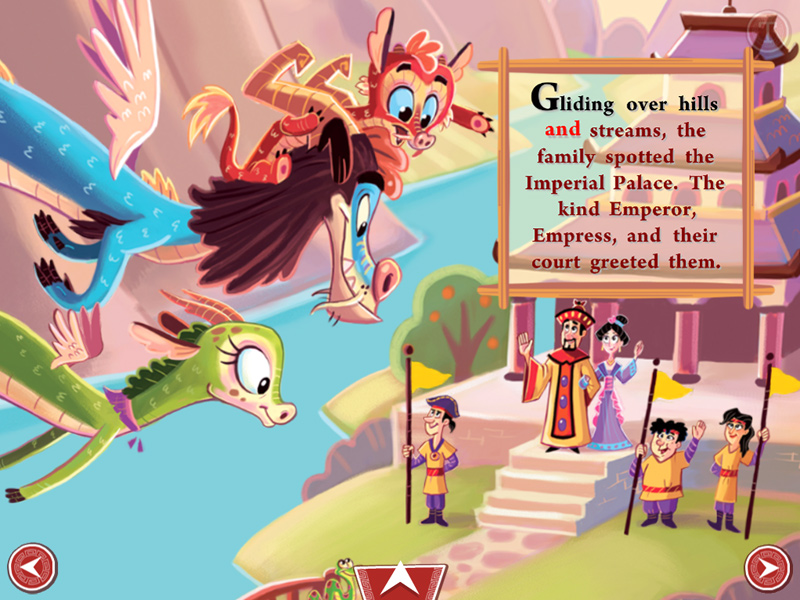
The Year of the Dragon is a sweet, simple story of Baby Dominic, a newly hatched dragon whose parents remind him of what makes their kind so special. "Who blows the winds? Who commands the rain? Who advises the Emperor? We do!"

When Baby Dom and all his friends from the zodiac team up together to win a race, he uses his own special dragon traits to save the day.

With fun interactivity that doesn't let tapping fingers get too distracted and vivid illustrations, The Year of the Dragon feels like a traditional book. And Mobad keeps the focus on literacy, as kids can choose to hear a narrator tell the story and follow along as each word is illuminated, or read to themselves. And if a child stumbles across an unfamiliar word, Mobad has made learning new vocabulary easy: she can just tap on the text and hear it pronounced.

The age range for Year of the Dragon is broad, as the youngest app set will adore Dom and the interactive features, and emerging and confident readers will enjoy the storyline, the other Chinese zodiac characters, and the hidden surprises.

Priced at $4.99.

Wednesday, January 18, 2012

Quality Kids Apps: Beyond the $0.99 Download

I wanted to share an interesting post over at Wired's Geek Dad about the future of apps for children. The author, Daniel Donahoo, talks about a push toward app development for children that is purposeful rather than just profit-driven. And while it might sound like an idealized world he's seeking, it is one worth striving for: quality products geared for kids that can harness all that finger-tapping energy for good.

Donahoo imagines "medium-sized independent and corporate developers of children’s apps existing side by side, all pushing each other to produce better digital tools for kids' learning and development. But I believe it has something to do with the crowd and also educating and supporting parents to make the best consumer choices and to support a breadth of apps and digital tools – not just the same old franchised apps from movies and books that we see everyday."

A key point Donahoo notes, among many, is pricing. "If we are to sustain the vibrant and dynamic number of children’s app developers we need to move beyond the 0.99c app. Consumers are currently downloading content for children that is at bargain basement prices and the problem is that could drive some of the key innovators out of their own development studios and over to larger players, or away from children’s apps and into more profitable digital arenas."

I think of this as the Organic Milk Approach. I pay a little more for organic milk because I believe it's better for my kids' developing brains and bodies, I want to support organic farmers and keep them in business, and I want to ensure that higher-quality products like this stay in the mainstream market.

Same for quality children's apps.

Donahoo and Andy Russell, co-founder of Launchpad Toys and the much-lauded children's app Toontastic, have put forth The Children's App Manifesto and begun pushing educators, marketers, investors, app developers, and most importantly parents to think about ways to best support quality educational digital content.

After my first-grader asked me just a few days ago to wake him up at 5 a.m. so he could harvest his Smurf pumpkins -- and purchase a few Smurfberries too -- two Manifesto items hooked me right away:

  • Play should not be over-commercialized by consumable goods nor advertisement.
  • Apps should not disguise costs nor manipulate children’s emotions to entice spending.

Monday, January 16, 2012

Magic School Bus: The Future of E-Learning

My first-grader was excited to use a coupon at his school's paperback bookstore the other day, and I stopped him. He had in his hands a copy of The Magic School Bus: On the Ocean Floor, and I, as if moving in slow motion, pointed back toward the bright yellow bookshelf and told him to pick another book. I was experiencing a complete out-of-body moment, hearing my voice from some far away place tell him, "We can download this book. It will be way better on the iPad."

And it is.

Bypassing a paper book for a digital one is still a new thing to me. And I am squeamish about it sometimes, fearing that my favorite neighborhood haunt, 57th Street Books, will disappear because I opt for an app instead of a former tree. So moments like the one at my son's school make me itchy.

But let's face it, digital books can do things that paper cannot. And in some realms, such as the informative, nonfiction picture book world where Magic School Bus dominates, the digital version is unbeatable. One look at the Oceans app, and the future of e-learning becomes clear.

The first real interactivity comes when young readers tap the bubbling water near an illustration of a sea urchin. A screen rolls down, and quick-hit bulleted points about sea urchins appear beneath a short video clip of an actual sea urchin. Budding naturalists can watch a spiny purple creature scoot along the ocean floor -- not just an artist's rendering of it, but actual undersea footage.

Interactive games demonstrating how various sea life swims teach the difference between a whale's means of locomotion vs. a squid's vs. a jellyfish's. Detailed photographs of sea stars, limpets, periwinkles, and others offer real-life examples of sea animals kids might not otherwise get to know. More video clips of flounder drifting among rocks drive home the benefits of camouflage.

Aside from showing kids the habitats and behaviors of undersea life, as well as showing phenomena like hot water vents and ocean waves, the app offers a variety of entry points for literacy learning. The read-along narration illuminates each word in red as it is spoken. Little fingers can tap the dialogue bubbles and hear the kids and Ms. Frizzle ask questions or comment on the scene as they read the words in the speech bubble. Whether a pre-reader or a confident one, the app is accessible to many levels.

Priced at $7.99, $1 more than the paperback, this book is packed with opportunities for interactive, exciting learning. Consider it a kid-friendly Jacques Cousteau adventure, right at young readers' fingertips. Magic School Bus: Oceans presents the best digital media has to offer young learners. Worth checking out immediately.