Thursday, February 9, 2012

Keeping Research on Digital Learning and Children's Digital Literature Alive

Back in the summer, dotMomming featured a series of interviews with Patrick Cox of the Childhood Studies Program at Rutgers University. Patrick was teaching classes on learning to read in the digital age, and we believe the work he and his colleagues are doing is important to understanding how digital books impact early literacy development for today's generation of children. But that research might be coming to a halt, and what follows is a special guest post from Patrick about how you can help keep programs like his alive.

From "Merry Conceits and Whimsical Rhymes."
Published by Routledge & Sons, New York, 1883. 
Awhile back, I did an interview on dot.Momming about an undergraduate course I teach at Rutgers on Children’s Digital Literacies. Since that time I’ve been including this blog in my course as a resource students can use to learn about still more digital texts for children beyond what we can cover in class. Kate has been kind enough to let me come back to tell you about a threat that has befallen this course.

My course is part of the Department of Childhood Studies, a one-of-a-kind program on the Camden campus of Rutgers University, offering the only Childhood Studies Ph.D. in North America. Recently, a plan has emerged in New Jersey to shut down the Rutgers-Camden campus and absorb it into a much smaller and less prepared college that lacks both the research focus and the child focus of the Camden campus of Rutgers.

This Rutgers campus is home to leading research and instruction in children’s digital literature. Students and faculty here study and teach digital texts created for children, stories written by children using new digital media, children using online virtual spaces, and how “the digital age” impacts literacy, learning, family interactions, and children’s daily lives. In my course students, many of whom are aspiring teachers, learn about digital literature and its potential for enriching use in classrooms and in homes. This campus is also home to the Center for Children and Childhood Studies that provides much needed assistance, programming, tutoring, and more to the children of the city of Camden.

All of this has been possible with the support and recognition that comes with being a first-rate university like Rutgers. If these programs are moved to a smaller, lesser known facility 20 miles outside of the city, they will most likely wither and die -- faculty and students will leave, and the work we have done will come to an end.

Students, faculty, alumni, and community members have been fighting hard to protect what we have. Kate has kindly allowed me to ask you to help maintain the work we are doing with and for children, and our field-leading work on the developing area of children’s digital literature. Here is a link to a petition started by a Rutgers undergraduate student to Stop the Merger. The petition has collected over 8,000 signatures in just two weeks, and I hope you’ll add yours. I won’t deluge you with links here but will point out that the student behind the webpage has loaded it with links to more information, news articles, etc., as well as other ways you can help if you so desire.

Thanks,
Patrick Cox
Department of Childhood Studies
Rutgers University-Camden

Wednesday, February 1, 2012

Happy Digital Learning Day!

Today marks the first ever national celebration of Digital Learning Day, which is an orchestrated effort to promote the innovative use of technology in America's classrooms. What does that mean and who is behind it?

Digital Learning Day is meant to encourage teachers, parents, and students to try something new using technology. This means showcasing success such as students' Scratch programs, kicking off project-based learning by letting students present video book reports, or simply sitting down with digital books and observing how young readers interact with the stories. The New York Times blogs about its 40-odd years covering technology and education, and encourages everyone to try three new things involving digital learning today.

There will be webcasts. There will be virtual town hall meetings. There will be Facebook-ing and Twitter-ing and all sorts of conversations going on about engaging technology for learning. And there will be heavy hitters, as the Alliance for Excellent Education has partnered with Google, USA Today, Intel, and other major players like Kaplan, Scholastic, and Houghton Mifflin Harcourt. Parents and teachers can make good use of toolkits and contests to motivate and engage their kids.

So why all the hoopla? Because so many questions surrounding the good use of technology remain:  how schools can first of all access digital technology and then harness it. How we can move our kids from the addictive fun of Plants vs Zombies and into engaged online learning that taps their creativity and opens the doors to real mastery and student success.

Because technology, while influencing our lives on a day-to-day basis at home and work, too often stops short of the classroom door.

Wednesday, January 25, 2012

App Review: Chinese New Year With a Dragon

Hearty "gung hei fat choi" to everyone out there, and happy Year of the Dragon. In honor of the turning of the Chinese calendar, to 4710 for those keeping track, we're taking a look at a brand new picture book app from Mobad Media called The Year of the Dragon.

The tale of the Chinese zodiac and that smarty-pants rat makes a fun story, whether for children or adults. And interpreting the characteristics of each of the twelve symbols can be a hoot for kids. My family is fascinated with the zodiac animals, and they often chalk up the behavior of others to the sign under which they were born. "What do you expect, Mom? He's a Tiger!"

And as with any reading of the zodiac, we are quick to lay claim to the positive attributes associated with our own symbols. I'm a sheep (observant! artistic! ingenious!), and I live with a couple of monkeys (self-assured, competitive innovators), one horse (cheerful, quick-witted talker), and a bunny rabbit (elegant and compassionate artist). And when we meet someone who shares our sign, there's immediate sympathy. It's like finding the kinship of another Bears or White Sox fan without all the messy logos.

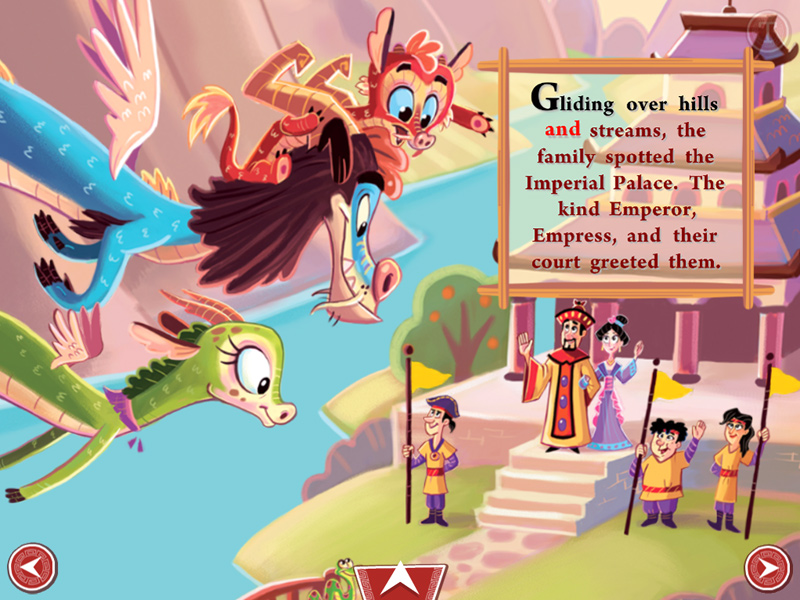
The Year of the Dragon is a sweet, simple story of Baby Dominic, a newly hatched dragon whose parents remind him of what makes their kind so special. "Who blows the winds? Who commands the rain? Who advises the Emperor? We do!"

When Baby Dom and all his friends from the zodiac team up together to win a race, he uses his own special dragon traits to save the day.

With fun interactivity that doesn't let tapping fingers get too distracted and vivid illustrations, The Year of the Dragon feels like a traditional book. And Mobad keeps the focus on literacy, as kids can choose to hear a narrator tell the story and follow along as each word is illuminated, or read to themselves. And if a child stumbles across an unfamiliar word, Mobad has made learning new vocabulary easy: she can just tap on the text and hear it pronounced.

The age range for Year of the Dragon is broad, as the youngest app set will adore Dom and the interactive features, and emerging and confident readers will enjoy the storyline, the other Chinese zodiac characters, and the hidden surprises.

Priced at $4.99.

Wednesday, January 18, 2012

Quality Kids Apps: Beyond the $0.99 Download

I wanted to share an interesting post over at Wired's Geek Dad about the future of apps for children. The author, Daniel Donahoo, talks about a push toward app development for children that is purposeful rather than just profit-driven. And while it might sound like an idealized world he's seeking, it is one worth striving for: quality products geared for kids that can harness all that finger-tapping energy for good.

Donahoo imagines "medium-sized independent and corporate developers of children’s apps existing side by side, all pushing each other to produce better digital tools for kids' learning and development. But I believe it has something to do with the crowd and also educating and supporting parents to make the best consumer choices and to support a breadth of apps and digital tools – not just the same old franchised apps from movies and books that we see everyday."

A key point Donahoo notes, among many, is pricing. "If we are to sustain the vibrant and dynamic number of children’s app developers we need to move beyond the 0.99c app. Consumers are currently downloading content for children that is at bargain basement prices and the problem is that could drive some of the key innovators out of their own development studios and over to larger players, or away from children’s apps and into more profitable digital arenas."

I think of this as the Organic Milk Approach. I pay a little more for organic milk because I believe it's better for my kids' developing brains and bodies, I want to support organic farmers and keep them in business, and I want to ensure that higher-quality products like this stay in the mainstream market.

Same for quality children's apps.

Donahoo and Andy Russell, co-founder of Launchpad Toys and the much-lauded children's app Toontastic, have put forth The Children's App Manifesto and begun pushing educators, marketers, investors, app developers, and most importantly parents to think about ways to best support quality educational digital content.

After my first-grader asked me just a few days ago to wake him up at 5 a.m. so he could harvest his Smurf pumpkins -- and purchase a few Smurfberries too -- two Manifesto items hooked me right away:

  • Play should not be over-commercialized by consumable goods nor advertisement.
  • Apps should not disguise costs nor manipulate children’s emotions to entice spending.

Monday, January 16, 2012

Magic School Bus: The Future of E-Learning

My first-grader was excited to use a coupon at his school's paperback bookstore the other day, and I stopped him. He had in his hands a copy of The Magic School Bus: On the Ocean Floor, and I, as if moving in slow motion, pointed back toward the bright yellow bookshelf and told him to pick another book. I was experiencing a complete out-of-body moment, hearing my voice from some far away place tell him, "We can download this book. It will be way better on the iPad."

And it is.

Bypassing a paper book for a digital one is still a new thing to me. And I am squeamish about it sometimes, fearing that my favorite neighborhood haunt, 57th Street Books, will disappear because I opt for an app instead of a former tree. So moments like the one at my son's school make me itchy.

But let's face it, digital books can do things that paper cannot. And in some realms, such as the informative, nonfiction picture book world where Magic School Bus dominates, the digital version is unbeatable. One look at the Oceans app, and the future of e-learning becomes clear.

The first real interactivity comes when young readers tap the bubbling water near an illustration of a sea urchin. A screen rolls down, and quick-hit bulleted points about sea urchins appear beneath a short video clip of an actual sea urchin. Budding naturalists can watch a spiny purple creature scoot along the ocean floor -- not just an artist's rendering of it, but actual undersea footage.

Interactive games demonstrating how various sea life swims teach the difference between a whale's means of locomotion vs. a squid's vs. a jellyfish's. Detailed photographs of sea stars, limpets, periwinkles, and others offer real-life examples of sea animals kids might not otherwise get to know. More video clips of flounder drifting among rocks drive home the benefits of camouflage.

Aside from showing kids the habitats and behaviors of undersea life, as well as showing phenomena like hot water vents and ocean waves, the app offers a variety of entry points for literacy learning. The read-along narration illuminates each word in red as it is spoken. Little fingers can tap the dialogue bubbles and hear the kids and Ms. Frizzle ask questions or comment on the scene as they read the words in the speech bubble. Whether a pre-reader or a confident one, the app is accessible to many levels.

Priced at $7.99, $1 more than the paperback, this book is packed with opportunities for interactive, exciting learning. Consider it a kid-friendly Jacques Cousteau adventure, right at young readers' fingertips. Magic School Bus: Oceans presents the best digital media has to offer young learners. Worth checking out immediately.

Wednesday, December 21, 2011

Cinderella : Our Top Picture Book App of 2011

We've kissed a lot of toads this year in app-land. Or maybe a more apt metaphor for this post would be along the lines of wedging our feet into a lot of ill-fitting slippers.

And while we've also stumbled across some real gems (see last week's post on the Best Picture Book Apps of 2011), our heart belongs to one big winner for the year. I'd like to devote this space to my No. 1 picture book app for 2011 with a few reasons why. So let's cut to the chase and reveal our winner. Drumroll please. . .

Nosy Crow's Cinderella takes a familiar tale and makes it extraordinary. Young readers can follow along with the text, then take a few moments on each page to interact with the story:

  • Help Cinderella clean up the kitchen by clicking and dragging fruits into the fruitbowl, stacking up the cups and plates, and throwing logs onto the fire. 
  • Get a little silly with the Stepsisters by dressing those soft-headed tyrants in ridiculous outfits for the ball.
  • Work with Fairy Godmother in the garden to turn the mice into footmen, the pumpkin into a carriage, and all the familiar ball-preparations. These tasks require real skills and include some fun surprises, which keep my young readers completely engaged.

But best of all is the ball itself, where Cinderella gets a few minutes alone with her prince. Nosy Crow does a great job making their books fun and a little unpredictable, and their Cinderella is no exception. Readers can have the happy couple dance a traditional waltz, break out their disco moves, or even go Bollywood. My first-grader comes down with a serious case of the giggles every time we get to the dance scene.

What appeals to me about Nosy Crow's apps is the emphasis on building literacy skills. These are, after all, books. And the audience is beginning readers. Nosy Crow's app hits the mark at many age levels and abilities, as more savvy readers can explore some of the nuanced humor throughout the story and early readers can tap on the characters to generate more speech bubbles that give clues about surprises on the page.

So what makes Nosy Crow's Cinderella No. 1? It's the perfect balance of a variety of factors:

  1. Top-notch illustrations
  2. Lively writing that puts a fresh spin on a familiar story
  3. Original interactive features 
  4. A commitment to early literacy
  5. Strong sense of fun
This sets the bar high for other app producers breaking into this new medium of children's literature, where the lines between book, movie, and game are often blurred in the push to attract kids. Hats off to Nosy Crow for getting it right, and having so much fun in the process.

Monday, December 12, 2011

Best Picture Book Apps of 2011

DotMomming apologizes for the November hiatus, but we were working on a bit of longer writing that required all our brainpower. But we're back in business, just in time for the holidays.

Both Kirkus Reviews and School Library Journal are great resources for finding helpful reviews not only of apps for kids but for all kinds of reading, like those things with paper. Their "Best Of" lists are rolling out for 2011, and we're hoping to see some of our favorite apps on there.

Here is dotMomming's rundown of our favorite picture book apps of the year:

For the youngest iPadders, Chronicle's Animal Show is adorable. With a festive, circus vibe in the visuals and audio, little swipers can learn to identify 31 animals -- tap on the sheep and hear it bah-bah-bah -- play matching games, test their memory, and work on counting skills. A definite keeper that they'll want to go back to again and again. ($1.99)

We also love the bedtime app Nighty Night! HD ($1.99) from Shape Minds and Moving Images and created by Oscar-nominated animator Heidi Wittlinger. In this beautifully rendered app, young readers get to put the animals to sleep all around the farm by turning out the lights. This is a perfect example of the magic apps can conjure -- the child is the actor and gets to decide when to make the bedtime call on every page. And though I missed the merging of text with narration, my first-grader did not. Parents who want their kids reading or at least having literacy awareness might find the lack of words on the page disappointing as well. But still, the visuals and interactivity more than make up for it.

For parents who want their wee ones interacting with words, check out Sandra Boynton's The Going to Bed Book ($3.99), which allows for a great deal of fun but keeps wee readers focused on the task at hand -- getting under those covers and calling it a day. Created by the wizards over at Loud Crow, the Boynton apps are not to be missed. Every one is a gem, offering kids the choice to have the story read to them or letting them read it themselves. Boynton books are for the youngest readers who are developing literacy skills, so the highlighting of words to flow with the narration and the subtle cues to move us along through the books go a long way in teaching kids the basic mechanics of reading. Loud Crow is a name you can trust.

And while there are plenty of big names in the App Store now -- from Mo Willems' Don't Let the Pigeon Run This App to the Fancy Nancy franchise -- we like what's coming from the smaller producers, too. Teddy's Night ($0.99) from Auryn is an adorable app about what a teddy bear is up to at bedtime. The soft, pastel illustrations set just the right tone, the child's narration is charming, and the interactive elements are surprising and entertaining without taking away from the story.

We've written before about Crab Hill Press, and their My Dad Drives a Roller Coaster Car ($1.99) is still one of our all-time favorite apps. Two words: rollicking hilarity! Forget about minivans, the little boy in this story has a family that drives wild ride rides from the amusement park, like a merry-go-round horse and a spinning teacup and a roller coaster car. With a beach-blanket-bingo party soundtrack, this app is a gas, and the type of story they'll return to again and again. Here's hoping Crab Hill has more great things to come in 2012.

Next up: A review of our No. 1 pick for 2011. Stay tuned. . .